


Only about 0.16% of the world’s population has completed a marathon since the 2000s and somehow I’m now part of that tiny group but this achievement came at a strange time.
You may have noticed that I skipped the last two newsletters. It’s been difficult to write while the world feels anything but normal. My home country of Lebanon is currently in the middle of a conflict and many of my friends and family are directly affected.
When things like that happen, celebrating personal achievements can feel insignificant. Yet life goes on and so did this marathon.
The Circumstances
Race day arrived under unexpected conditions.
My marathon happened:
One week after war broke out in Lebanon
During the month of Ramadan
On a hot day in Los Angeles
Even though I wasn’t fasting on race day, I had been fasting for the three weeks leading up to it. That meant completely changing my routine. My runs shifted to the evenings after breaking my fast, my sleep schedule moved later and my training suddenly felt less under control.
Instead of sleeping around 10 or 11pm, I found myself going to bed closer to 1am and then the war started.
For five months, this marathon had been the center of my life. Suddenly, it felt small compared to what people back home were going through. I didn’t know how to feel anymore.
But one thing was clear: I had already committed to the journey. I wasn’t going to quit now.
The weather added another twist. One of the reasons I chose the LA Marathon in March was because I expected winter training but Los Angeles had other plans. In five months, I ran in the rain only twice. Most runs felt like summer. Dehydration became a bigger challenge than cold weather.
Race day followed the same pattern: warmer than expected.
Luckily, marathons start early. Ours began at 7am, which meant the real heat didn’t hit until later in the race.
The Race
The marathon itself is a strange event.
In many ways, race day is the victory lap, a celebration of months of training. But at the same time, it’s the hardest run you’ll ever attempt, especially the first time.
Most marathon training plans peak at 20 miles (32 km).
The marathon itself is 26.2 miles (42.2 km).
That means race day adds an entire 10K race beyond the longest distance you’ve ever run.
And the LA Marathon adds another layer: about 950 feet (290m) of elevation gain, which makes it a challenging course.
My target pace going into the race was 8:45 minutes per mile (5:26/km). For non-runners, that’s roughly 11 km/h — not elite speed, but faster than the average runner could comfortably sustain.
Three weeks before the race, though, I started feeling something shift since the beginning of Ramadan. I was still hitting my training paces, but they required more effort than before.
Then came race morning.
I had only slept about five hours, but I still felt ready.
A few miles into the race, reality set in. I could tell maintaining my goal pace for the full marathon might not happen today.
That’s when something interesting happened mentally. Instead of panicking, I shifted my mindset.
For five months I had been learning a simple truth: marathon training is full of ups and downs. Some things are simply out of your control but missing a target time wouldn’t erase the accomplishment. Finishing would still be huge.
So I let go of the sub-4-hour goal and focused on running a steady pace.
I ended up running around 9:35 per mile for most of the race. Slower than planned but still impressive.
And the biggest surprise? I never hit the wall.
In marathon world, runners talk about “the wall” at mile 20, when glycogen depletion causes sudden extreme fatigue. It’s the point where many runners struggle to continue.
I was definitely tired but I never felt like I couldn’t keep going.
What I remember most is actually feeling impressed with my own body. Fatigued, yes, but still moving forward with strength.
The People
One of the most powerful parts of marathon running isn’t the distance.
It’s the people.
Spectators line the streets cheering not just for friends and family but for complete strangers. People hand out oranges, water, snacks, massage guns, pain relief sprays and endless encouragement.
Running through those crowds reminds you of something important: most people are good. The negativity we often see in the world rarely represents the majority.
One of the biggest boosts of the race came at mile 18, when I saw my family and friends cheering for me after about two and a half hours of running. Their energy carried me forward.

One small regret though: I didn’t stop to truly take in the moment. The adrenaline was high and I kept running.
I got to see them again near the finish line.
The Finish
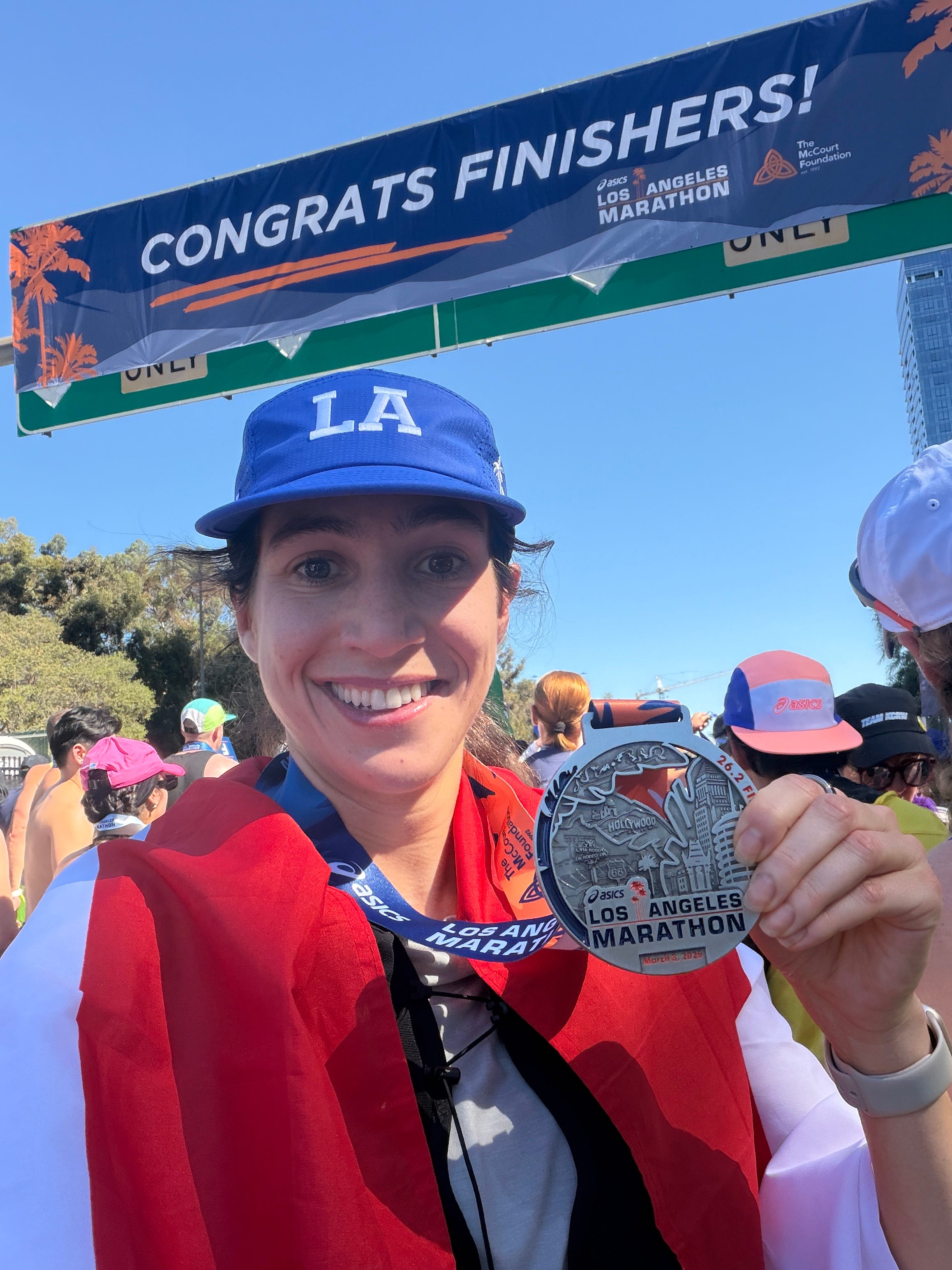
After 26.2 miles, I crossed the finish line in 4:11:09.
Not the sub-4 time I had hoped for but still a strong first marathon.
And more importantly, I finished.
Reflection
If I’m honest, part of me did feel slightly disappointed.
I’ve spent most of my life as an athlete. When I set goals, I like to achieve them. A small voice in my head kept saying I had more in me that day. Which probably means this won’t be my last marathon.
But the biggest takeaway from the race wasn’t my time. It was the people who ran the marathon.
Over 30,000 runners participated in the LA Marathon. People of every background, every age, every ability. Some finish in around two hours and others take nine.
You see cancer survivors, elderly runners, disabled athletes, barefoot runners, people walking the entire course just to finish.
It makes you wonder: why would anyone sign up for something this difficult?
And then you remember your own reason.
For me, it started with wanting to challenge my inconsistency and prioritize my health.
But every runner there has their own story.
That’s what makes marathons special.
30,000 different motivations.
30,000 personal battles.
30,000 victories.
Final Thought
If you ever get the chance, sign up for a marathon or at least a half.
And if running isn’t your thing, go watch one.
Stand on the sidewalk and cheer for strangers.
You might be surprised how inspiring it is to see ordinary people doing something extraordinary.
Congratulations!!! Batale!!